
How to Get Minnesota Court Records
Minnesota Court Records Online (MCRO) is the first stop for eligible Minnesota District Court details. It opens public documents too. Courthouse computers allow in-person inspection. County District Court Administration staff can answer questions, pull a file, and issue copies. The Judicial Branch District Court directory lists contacts. Plain, non-confidential copies can be requested several ways. Use the statewide or local copy form, a letter, drop box, fax, or email where offered.
Know which Minnesota court file you need before asking for paper. The county and case type point to the right office. An event date or document index number narrows the request. Run the Minnesota case search first. Then follow the county route for a complete or certified Minnesota court record.
- Search MCRO by party name, Minnesota court file number, citation, or attorney and confirm the court location.
- Open Case Details in the Minnesota portal and note the Register of Actions event, date, and document index number if shown.
- Try MCRO Document Search by the Minnesota court file number for public online PDFs.
- If an image is absent or the file is older, contact the proper County District Court Administrator through the Minnesota county directory.
- Say whether you need Minnesota file inspection, a plain copy, a certified copy, or an exemplified copy; ask the county office about format, payment, and delivery.
Note: Before mailing a Minnesota records request, check which delivery and payment options the county office accepts.
Minnesota's Docket and Case File
Think of the Register of Actions as the case's index. A filing, hearing, order, or judgment shows up there. It appears even when the paper itself is not attached. MCRO Case Search opens that register. Minnesota Document Search works separately and hunts for public images by court file number. If an entry lists a document index number but no PDF, that number still helps. The custodian can use it to locate the item. The full county file may also hold exhibits, recordings, and paper records. MCRO's remote inventory does not cover all of them.
For a hearing date, trust the latest notice. For an order, request the signed filing rather than trusting the docket entry alone. An online PDF is uncertified. The County District Court Administrator holding the file can explain a missing item. It may be restricted, not imaged, archived, or simply stored in another format.
| Record layer | What it provides | Where it is held |
|---|---|---|
| Minnesota Register of Actions | Case events and document indexes. | MCRO remotely; Minnesota court administration and terminals for eligible records. |
| Filed Minnesota court document | A pleading, order, notice, or other item in the file. | MCRO if imaged and remotely available; otherwise county court administration. |
| Minnesota certified copy | A copy with court certification or authentication. | Request from the custodian for that court file. |
Types of Minnesota Court Records
A District Court file gathers the complaint or petition, the answer, motions, hearing notices, orders, judgments, exhibits, and transcripts. The clerk adds more entries along the way. The Register of Actions is the running index. The papers underneath it are the file. Docketed money judgments also surface through MCRO Judgment Search. Judgment details and satisfaction history come attached. A satisfaction entry is a court-system record, though, not a promise about a current balance.
Appeals open their own files at the Clerk of the Appellate Courts. Federal trial, bankruptcy, and appellate cases sit with federal clerks through PACER and CM/ECF. Those cases sit outside MCRO entirely. A transcript or recording is its own item. It is distinct from both a register entry and a written order.
Minnesota Court Records: Copy Forms
The Judicial Branch publishes a Minnesota Statewide Copy Request Form. A Minnesota copy-request forms page collects the options in one place. The statewide form wants your contact details. It also wants the case type and court file number, the party names, and the document you need. A strong request also gives the filing date or index number when known. It should name the copy type and say how you want it returned.
Delivery choices on the form cover mail, pickup, fax, email, or other prepaid shipping. Fax and email are limited to plain, non-confidential copies. No universal turnaround time or single payment method is promised. County forms sometimes ask for extra information or describe a local process. A restricted record may require proof of party status or a court order.
- Requester name, date, mailing address, phone, and email.
- Minnesota case type, court file number, and plaintiff/petitioner or defendant/respondent names.
- Requested Minnesota document, filing date or index number, and the number and type of copies.
- Delivery preference and any prepaid return shipping.
Note: The Minnesota statewide copy form promises no processing time and no single payment method for every county.
What a Minnesota Court Record Contains
What a record holds depends on the case and the access rules. MCRO's Case Details handout walks through the overview, parties, events, hearings, dispositions, finances, and document links. A criminal record may show charges, bond or bail activity, and conditions. Civil files can add attorneys and related cases. An event can appear on the docket without its image, and protected fields or attachments stay out of public view even when the entry itself is visible.
| Minnesota case information | Court file number, title, type, filing date, venue, judicial officer, and status where displayed. |
|---|---|
| Minnesota parties and attorneys | Roles and representation details subject to remote access and redaction rules. |
| Minnesota case events | Event descriptions, dates, and document index numbers, often in reverse date order. |
| Orders and judgments | Filed decisions or money-judgment details when accessible; use the document for the full terms. |
| Hearings | Scheduled or past events; the latest filed notice provides operative appearance instructions. |
| Exhibits and recordings | May require a separate request and judicial access approval. |
Minnesota Court Record Terminals and Archives
Every Minnesota courthouse keeps public terminals where anyone can search eligible case types for free. Searching on site can surface more court records than the MCRO remote display reaches. Confidentiality rules still apply. Rule 8 bars courthouse electronic access to Minnesota juvenile-protection material outright. Sealed data stays sealed, terminal or not.
Document images run deepest for eligible Minnesota District Court records filed on or after July 1, 2015. Some case categories carry a thinner image set. An older case can show up in MCRO without its historical paper. Closed files may sit in off-site storage. Ask the County District Court Administrator about a particular file. It may have been imaged, archived, retained elsewhere, or open to inspection in another format. Terminal locations, counter hours, and retrieval steps vary by county.
One local example is the Hennepin County Records Center page. It describes its own terminals and request channels. Its hours and procedures govern Hennepin alone.
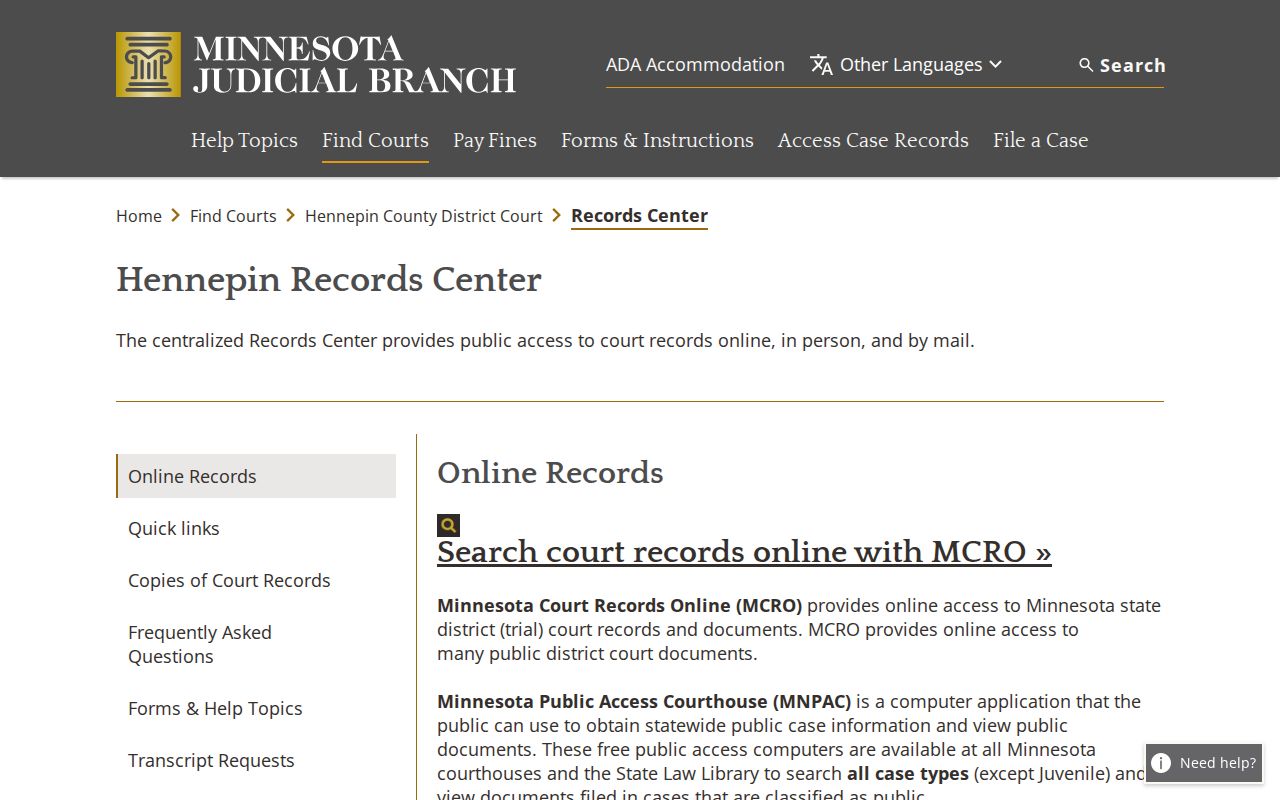
Outside Hennepin, go through the Minnesota county office where the case lives. That office posts its own terminal and counter details for the court docket you need.
Minnesota Certified Court Copies and Fees
Minnesota courts issue copies at three levels. A plain copy is just for review, with no certification. A certified Minnesota copy carries the court seal or official certification. The exemplified version adds authentication from both a judicial officer and the court administrator. Some receiving institutions insist on it. Explain to the custodian how you plan to use the record. Then ask which form fits. One limit exists. Court administration cannot certify a document it does not hold or one restricted from release.
| Copy or service | Statewide base amount | Details |
|---|---|---|
| Minnesota plain or uncertified copy | $0 | The former $8 copy fee ended July 1, 2023. |
| Minnesota certified copy | $14 per instrument | Base under Minn. Stat. § 357.021; a local law-library fee may apply. |
| Minnesota exemplified copy | $14 per instrument | Certified plus exemplified is $28. |
| MCRO online document in Minnesota | $0 | Free public download when available online. |
The Minnesota District Court fee table lists the base fees for court records and lets you pick a county law-library fee where one applies.
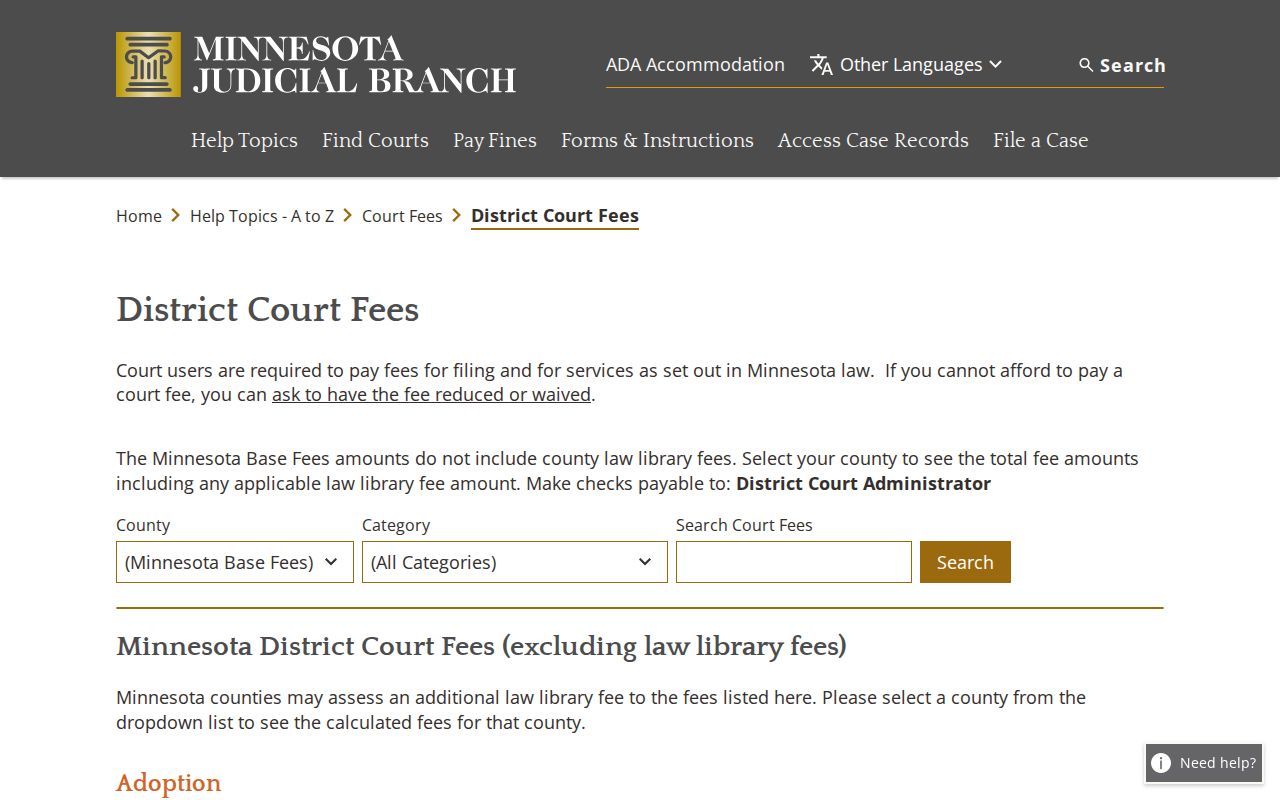
Before mailing any request, confirm the final Minnesota copy cost and accepted payment types with the county Court Administrator.
Note: a county law-library fee can shift the displayed total. MCRO searches and plain copies stay free under current policy.
Minnesota Court Records: Transcripts and Exhibits
A Minnesota transcript comes from a court reporter. It is neither a docket entry nor a filed exhibit. Published rates run $4.25 per page for criminal and juvenile-delinquency work. Civil, family, probate, child-protection, SPP, and SDP matters cost $5.75 per page. Expedited rates get negotiated case by case. The Judicial Branch reviews the schedule every two years. A public-input window was scheduled for September 16 through 30, 2026. Check the current policy and talk with the reporter before ordering.
For exhibits, the Minnesota Digital Exhibit System (MNDES) has been mandatory for electronic exhibits since January 1, 2025. Case participants use it to submit and manage exhibits. It is not a public evidence browser. Public access to an exhibit still requires judicial approval. It follows the access rules. So an exhibit named in the Register of Actions may not be downloadable from afar.
Minnesota Court Record Access and Sealed Files
Access to Minnesota judicial records runs through the Rules of Public Access to the Records of the Minnesota Judicial Branch. Rule 4 sorts the record categories. Rule 8 covers inspection, copies, bulk distribution, and remote access. Minn. Stat. § 13.90 keeps the judiciary outside the Minnesota Government Data Practices Act (MGDPA). It points instead to Supreme Court rules. So a Minnesota court-record request goes to the court custodian under those rules. It does not run through a county-government MGDPA process.
Juvenile, sealed, confidential, and nonpublic materials never reach MCRO. When a record is restricted, ask the District Court Administrator which rule or order controls. Also ask what review exists. For relief specifically, Chapter 609A governs expungement and section 260B.171 covers Minnesota juvenile delinquency records.
Minnesota record-access rules:
Minn. Stat. § 13.90 states that Minnesota judicial data access is governed by Supreme Court rules rather than chapter 13.
Rules 4 and 8 distinguish public status from electronic remote availability.
Minn. Stat. chapter 609A governs expungement and related sealing relief.
Request a Minnesota Court Record
When MCRO lacks the image, write to the County District Court Administrator. That office sits in the Minnesota county where the case was filed. Give the Minnesota court file number. Add the document title or index number, an approximate filing date, and the copy type you want. You may request a public terminal inspection or one specific public document. The statewide form sets no standard processing deadline. Older paper files may need retrieval time.
If access is denied, ask for the decision and its reasoning under the applicable Minnesota rule. Rule 7 sets the request procedures. Rule 9 supplies the review route after a denial. Each county administration office serves as custodian for its own Minnesota District Court file. The Clerk of the Appellate Courts handles state appellate copies. Federal records take a separate federal clerk and the PACER system. The Minnesota county directory points to each local court route and its current contact information.