
The Minnesota Court System
Minnesota runs a single Judicial Branch with three tiers. General-jurisdiction trials happen in the Minnesota District Court. Appeals usually go to the Minnesota Court of Appeals. The Minnesota Supreme Court sits at the top as the court of last resort. Each tier builds its own Minnesota case record. An appeal does not rewrite the trial file. For a trial-court docket, contact the County District Court Administrator. Use the office in the county where the case was filed. The Minnesota Judicial Branch court overview lays out this structure in full. One more piece worth knowing: Conciliation Court, the small-claims division, sits inside District Court.
| Court level | Role and docket | Search and file route |
|---|---|---|
| Minnesota Supreme Court | Highest state court; reviews Minnesota Court of Appeals decisions and specified direct-review matters. | P-MACS and the Clerk of the Appellate Courts. |
| Minnesota Court of Appeals | Intermediate appellate court; normally reviews District Court appeals in panels. | P-MACS and the Clerk of the Appellate Courts. |
| Minnesota District Court | General trial jurisdiction for criminal, traffic, civil, family, probate, juvenile, and other cases. | MCRO for eligible public remote access; county court administration for the official local file. |
| Conciliation Court | Minnesota’s small-claims division within District Court, with the same county-level record custodian. | MCRO District Court search and county court administration. |
An appeal opens a separate appellate case while county administration keeps the original trial file intact. Federal matters never enter this system at all; they run on their own separate docket.
Note: Judicial districts group county courts for administration; they are not a tier between trial and appellate courts.
Minnesota State Court Administration at Work
Minnesota splits the work. The Chief Justice of the Minnesota Judicial Branch heads administration, and the Minnesota Judicial Council sets policy for the courts. Day-to-day support comes from the Minnesota State Court Administrator's Office, which handles technology, case management, statistics, procedure, interpreters, research, and statewide programs. The office also publishes Minnesota court statistics. It does not hold trial-court files. Those stay with the County District Court Administrator, so file and counter work remain local while rules and technology are coordinated centrally.
State Court Administrator’s Office
Minnesota Judicial Branch administration, technology, court information, statistics, and statewide program support.
The Statewide Case Search Portal
Minnesota Court Records Online (MCRO) is the statewide search portal. It reaches Minnesota District Court records in all 87 county locations through four tools. Those are cases, documents, hearings, and money judgments. Field choices and result limits are covered in the Minnesota case search steps. What you can see remotely depends on the case category. It also depends on filing date, imaging, and the Rules of Public Access. MCRO calls its registers real time. It promises no refresh interval or uptime, though. Some events lack images, and older files may still need retrieval at the county.
| MCRO area | Public use | Boundary |
|---|---|---|
| Case Search | Find a District Court case and open its Register of Actions. | Remote name, case-type, and data-field rules still apply. |
| Document Search | Find public Minnesota documents online by court file number. | Not every public paper document has an online image. |
| Hearing Search | Locate scheduled District Court hearings in Minnesota and open case details. | Use the filed notice and court office for logistics. |
| Judgment Search | Find docketed money judgments and satisfaction history. | Not a current-balance determination or certified record. |
The official MCRO Case Search form is where a docket search begins. The public interface shows the search choices with no party or case information entered.
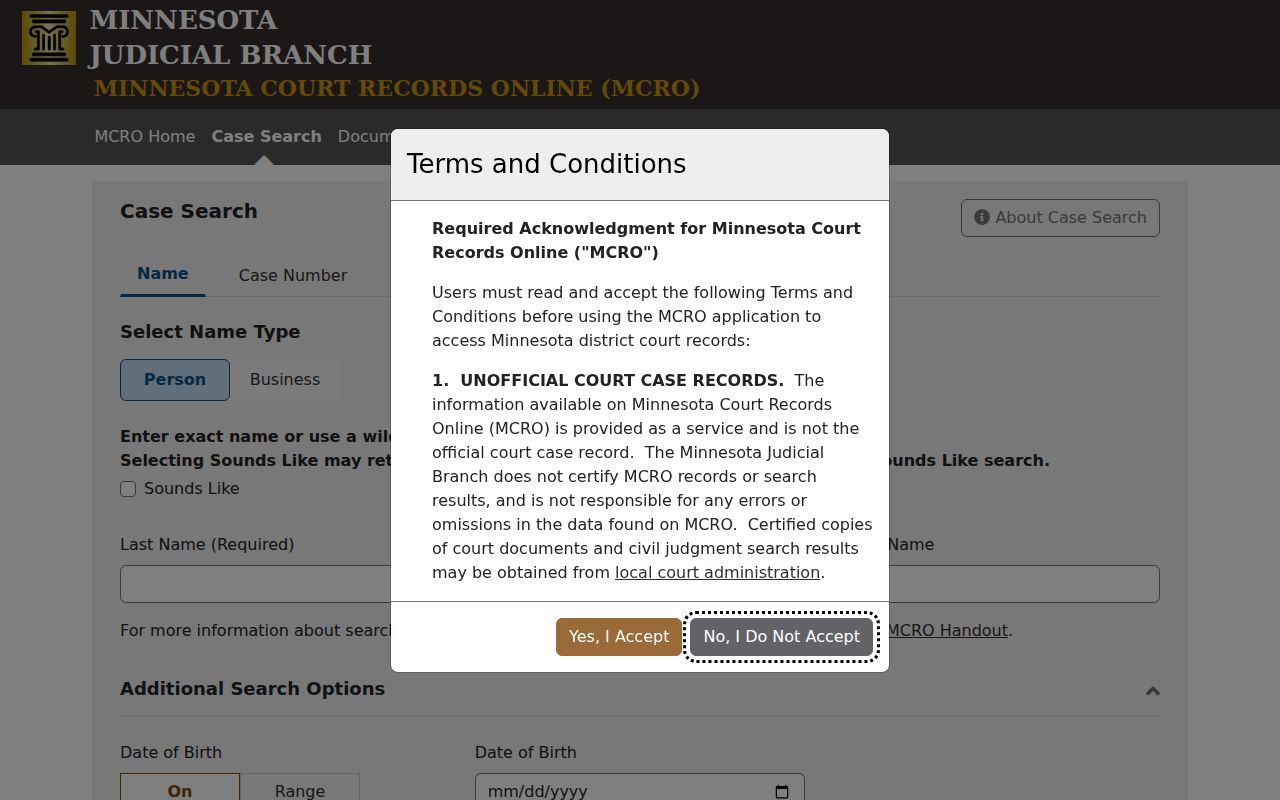
MCRO serves the public; e-filing and staff case management serve different users.
Minnesota MCRO Coverage Has Record Gaps
Statewide coverage does not mean everything is online. Broad MCRO document access covers public major and minor Minnesota criminal and civil matters, plus several probate categories filed from July 1, 2015. Family case images are narrower. So is Minnesota access to documents filed before that date. The current Minnesota access table sets the exact limits.
Some public documents never appear in the MCRO viewer at all. That includes civil commitment, domestic abuse, harassment, and felony delinquency for people age 16 or older. CHIPS cases are on the list too. Protected fields may be dropped from remote results too. A missing result can come from name matching, case restrictions, expungement, age, record destruction, or simply searching the wrong location.
Access distinction: Minnesota Rules of Public Access separate in-person inspection from remote electronic access. Minnesota courthouse terminals can show more public material, but juvenile-protection records and other restricted information remain unavailable there.
Minn. Stat. §13.90 carves the judiciary out of Minnesota's Government Data Practices Act and points to Supreme Court rules for access. Check the current rules index along with the MCRO access table for restrictions.
How Dockets Flow From County to State
Every Minnesota trial-court docket starts at county court administration. Eligible eFS submissions and other filings feed into the Minnesota Court Information System (MNCIS). MCRO can then display case events, parties, status, and hearings, following remote-access rules and wherever images exist.
Minnesota docket flow: Eligible eFS filing › Minnesota clerk intake and MNCIS › case event and document index › public Register of Actions and linked image in MCRO, when permitted and imaged
Not every record takes that path. Charges, citations, and court-generated material can enter differently. A document index may show no image, and paper or archived files can still sit in the county office. For case questions, the Minnesota county directory routes you to the right place.
Minnesota Court Districts Are Administrative Groups
Minnesota's ten judicial districts group District Courts across all 87 Minnesota counties. Each district has a chief judge and an administrator who coordinate calendars, assignments, and practices. They never replace the county administrator holding the actual case file. Venue and local administration follow the filing county. A case can move between judges or court locations. The county office holding the record does not change. Event questions, older files, and copy requests still go through the county route.
Ten judicial districts group Minnesota counties for administration; they are not separate trial courts between the county District Court and the appellate courts.
Minnesota eFS and E-Filing
Minnesota Judicial Branch eFile and eServe (eFS) handles eligible Minnesota District Court filings and service. Minnesota attorneys and specified government or justice users generally must file this way. Self-represented users may opt in. Eligibility depends on their case and document type. Mandatory e-filing ran statewide across Minnesota District Courts by July 1, 2016. It arrived after a phased rollout.
A filing status back from eFS does not guarantee a public MCRO image. Clerk processing is still required. Fees vary by transaction, though public MCRO viewing is free. Appeals take a different route through Minnesota's E-MACS service.
The Minnesota eFile and eServe portal is the filer-facing entry point statewide. The portal view shows sign-in and account landing choices rather than a case docket.
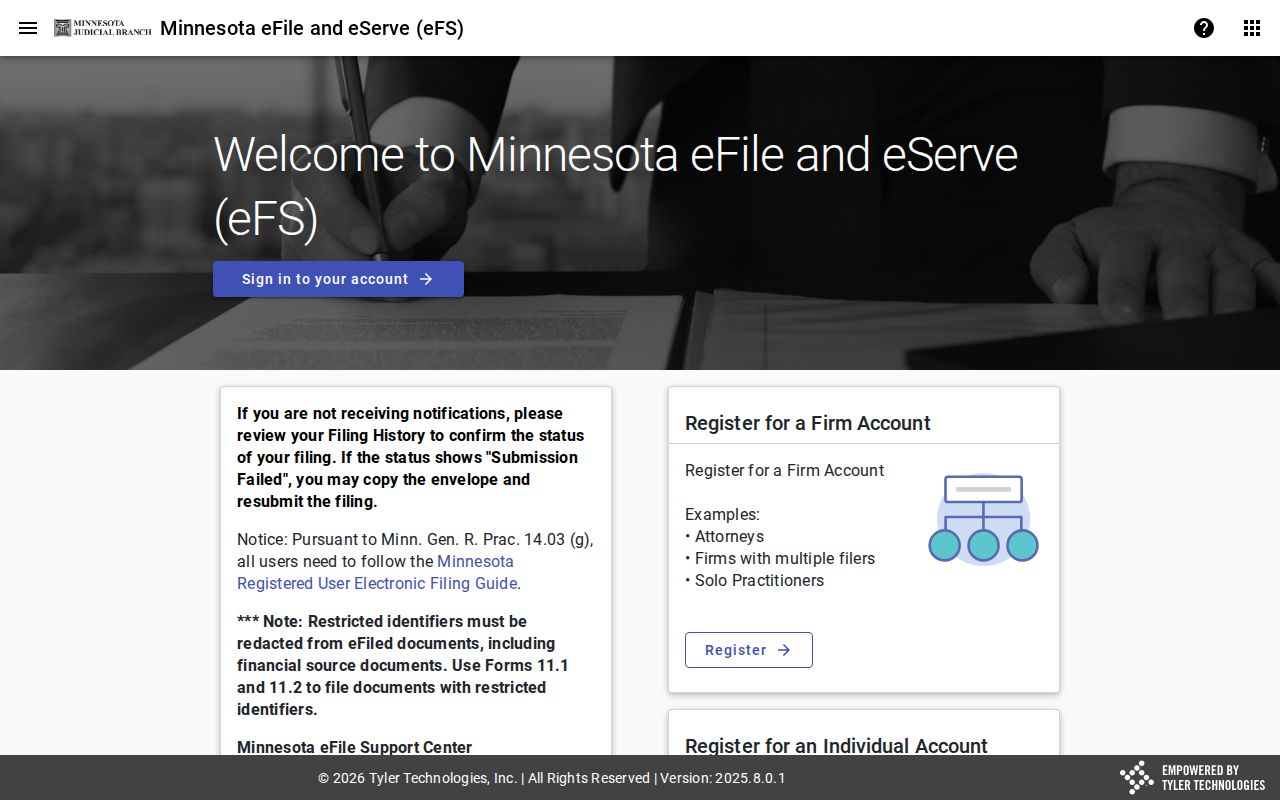
Filing and service happen in the portal. The public case register is a separate search through MCRO, available after court processing and subject to the access rules.
Note: Not every Minnesota initiating record is submitted by an attorney through eFS, and filing status is not the same as public remote availability.
Why Minnesota eFS Is Not the Public Docket
Think of three tools doing three jobs. Minnesota eFS is how a filer submits an eligible document. MNCIS is the statewide case-management system court staff use behind the scenes. MCRO is the public window. Anyone can run a Minnesota court docket search there on District Court cases.
A document travels that pipeline before it shows up anywhere. A filer sends it through eFS. Staff process it into MNCIS. A public user can then find the case or its Register of Actions in MCRO.
One catch matters. A court event can appear in the public register without its filing image. Confidentiality designations, remote-access rules, imaging, and clerk processing all shape what MCRO displays. Minnesota Court Records Online does not certify a court file. It does not take filings. It also does not replace the official record custodian at the county.
Note: A filing timestamp, a register event, and an online document image are related stages, not one interchangeable status.
Statewide Portal vs County Docket
MCRO indexes a wide share of public Minnesota District Court cases. The trial-court record itself stays with the District Court Administrator. That office sits in the county where the case was filed. A portal hit gives you a case number. It may also link a public register or a filed document. It is not a substitute for the paper file. Nor does it replace a certified copy or the most current local notice.
Once you know the filing county, the Minnesota county directory is the practical next step. A courthouse computer in Minnesota gives eligible users another way to reach records. Copy requests go through the county office. So do archive searches and questions about a specific docket.
| Record need | Statewide MCRO | County court administration |
|---|---|---|
| Locate a District Court case | Search across all Minnesota county locations or narrow by county. | Confirm the local file and answer a case-specific question. |
| Check docket events | Read the remotely available Register of Actions. | Clarify local event details and locate older records. |
| View documents | Open public online images available through MCRO. | Ask about a public document not imaged online. |
| Get a certified copy | Search results and downloads are not certified. | Request the authenticated copy from the county record custodian. |
Minnesota Appeals Have a Separate P-MACS File
An appeal from Minnesota District Court opens a second case record. The county register might note an appeal notice or a record-transmission event. The appellate case number, schedule, motions, briefs, orders, and opinions all live somewhere else. That somewhere is P-MACS. It is the search system for Minnesota Court of Appeals and Supreme Court cases.
P-MACS is separate from MCRO. The Clerk of the Appellate Courts is the record contact for that Minnesota appellate docket. The county is not. Searching is free. Cases opened from March 3, 2003 carry fuller details than older, often abbreviated files. Not every appellate document is available remotely.
The official P-MACS access screen is the entry point to the Minnesota appellate case system. Treat it as its own path for an appeal rather than another tab in the District Court search.
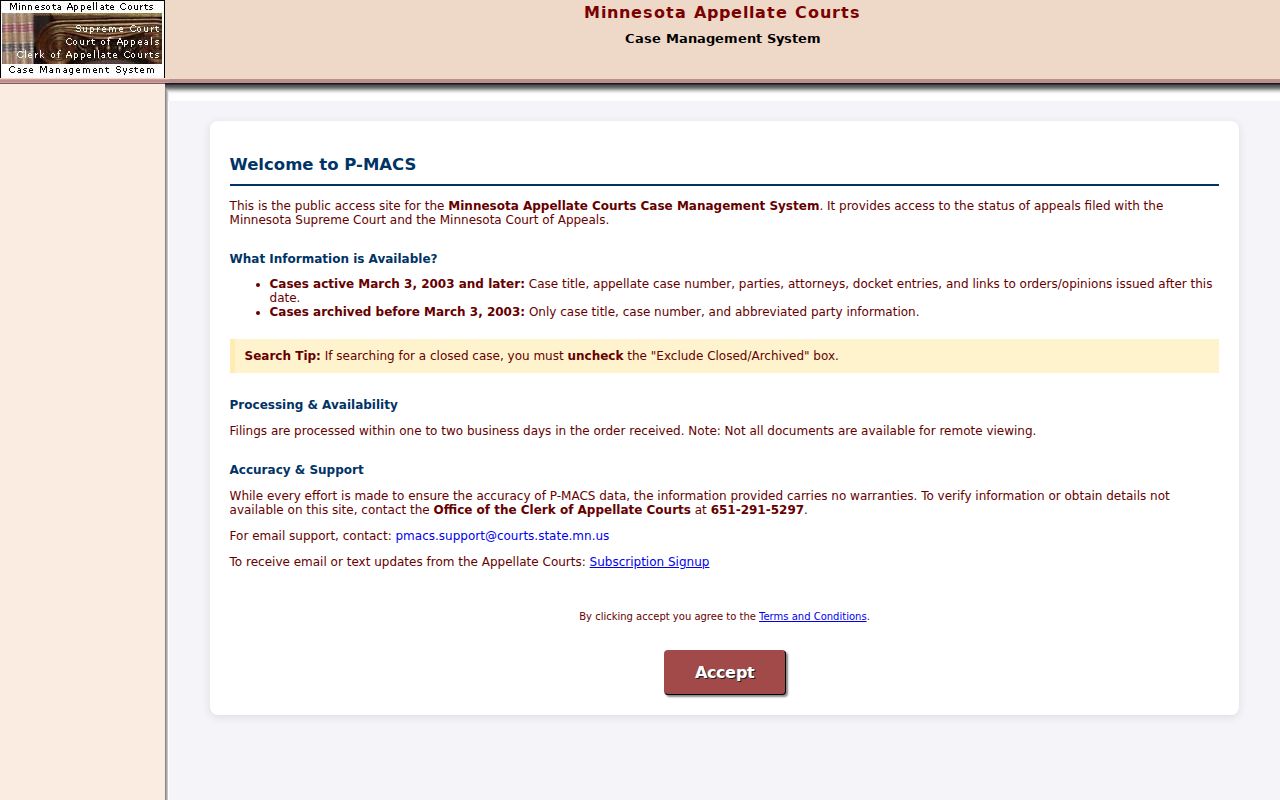
Missing an appellate document or a certified paper copy? Contact the Clerk of the Appellate Courts, not the county office holding the original District Court file.
Minnesota Court Scale and Case Access
Published figures describe Minnesota's court structure, not case totals or public-search records. The system spans county venues, administrative districts, and appellate courts, tied together by a shared online index while the files themselves stay with the counties.
| County District Courts | 87 county courts in Minnesota’s statewide District Court system. |
|---|---|
| Judicial districts | 10 administrative groupings of the county courts. |
| Authorized judgeships | 322 total: 7 Supreme Court, 19 Court of Appeals, and 296 District Court judgeships. |
| Hearing facilities | 103 Judicial Branch facilities; these are locations, not an added court tier. |
For filing trends, the 2024 Minnesota Performance Measures Annual Report is the source. FY2024 filings ran 3% above FY2023. They came in 2% below FY2020. The report also shows the major criminal pending caseload back to pre-pandemic levels by May 2024. These numbers describe system workload, not one case's timing or outcome.
Note: Filing totals use different units across categories, so a reported percentage change should stay attached to the measure and year it describes.
Minnesota Court Technology and History
Minnesota's public docket grew alongside changes in governance, e-filing, case management, and remote access. State funding of Minnesota courts arrived in 2005. That same year, the Judicial Council became the single statewide policy body. District Court e-filing expanded before MCRO replaced MPA Remote in stages.
- 2005: State funding of trial courts and Judicial Council governance expanded the statewide administrative structure.
- July 1, 2016: Mandatory e-filing was in place statewide for District Court operations after a phased rollout.
- March 2021 to August 2022: MCRO launched Document Search, then added Case Search and the Register of Actions, followed by Hearing Search and Judgment Search.
- April 17, 2023: MPA Remote ended, leaving MCRO as the public remote case-access platform.
- January 1, 2025: The Minnesota Digital Exhibit System became required under a statewide exhibit order; eCheck-In became available in most counties for eligible hearing participants later that year.
Two newer tools have narrow jobs. MNDES governs exhibit submission, not public access to all evidence. eCheck-In lets eligible participants confirm arrival before a hearing; it never replaces a notice or changes a setting. For docket research itself, county custody and access rules still govern what you can see.
Note: Electronic case access developed in stages, and older paper files may still need a county archive search or courthouse inspection.